MENU
Learn the main differences between existing electronic signatures and identify which one best suits your organization's needs.

An advanced electronic signature is generated using a cryptographic tool, such as the SAT's e.firma, which consists of a public certificate and a private key.
The e.firma and equivalent tools are generated by entities called Certification Service Providers (the SAT being one of them), following a rigorous identity and biometric data verification process as detailed in Article 97 of the Commercial Code.
It is precisely the rigor of this process that gives advanced signatures generated using these tools the highest level of legal robustness.

Any electronic signature that meets the requirements of Article 89, but not the additional requirements of Article 97 of the Commercial Code, is considered a simple signature.
For it to be considered an SES, there must be an exchange of secret keys and passwords during the document signing process. Examples include:
- Entering a username and password
- One-time codes generated by a “token”. For example, a mobile banking app that generates a unique code for transactions.
- Use of a private key that is under the exclusive control of the signer.
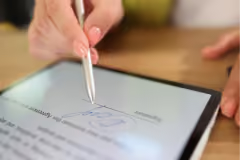
This is when you draw your handwritten signature with a finger or stylus on a phone, computer, or tablet.
Many international electronic signature platforms use this type of signature.
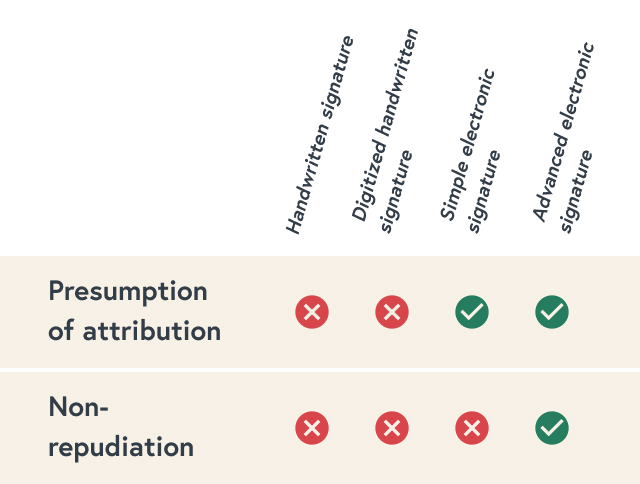
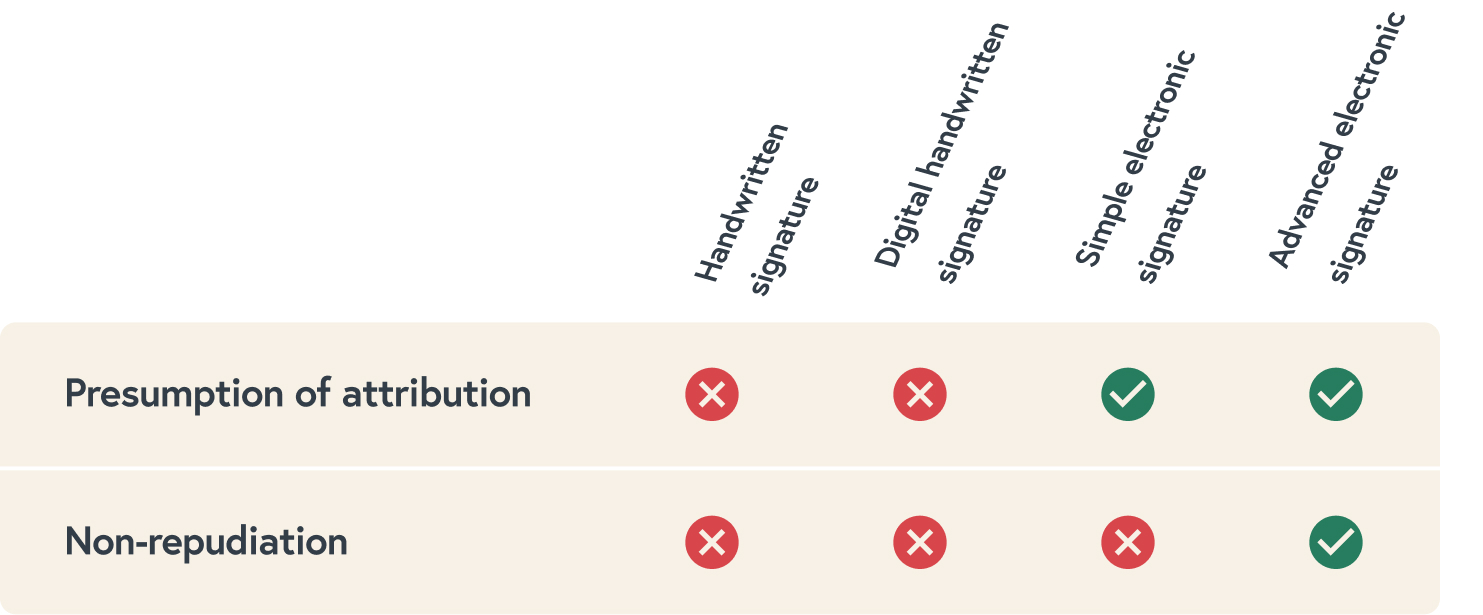
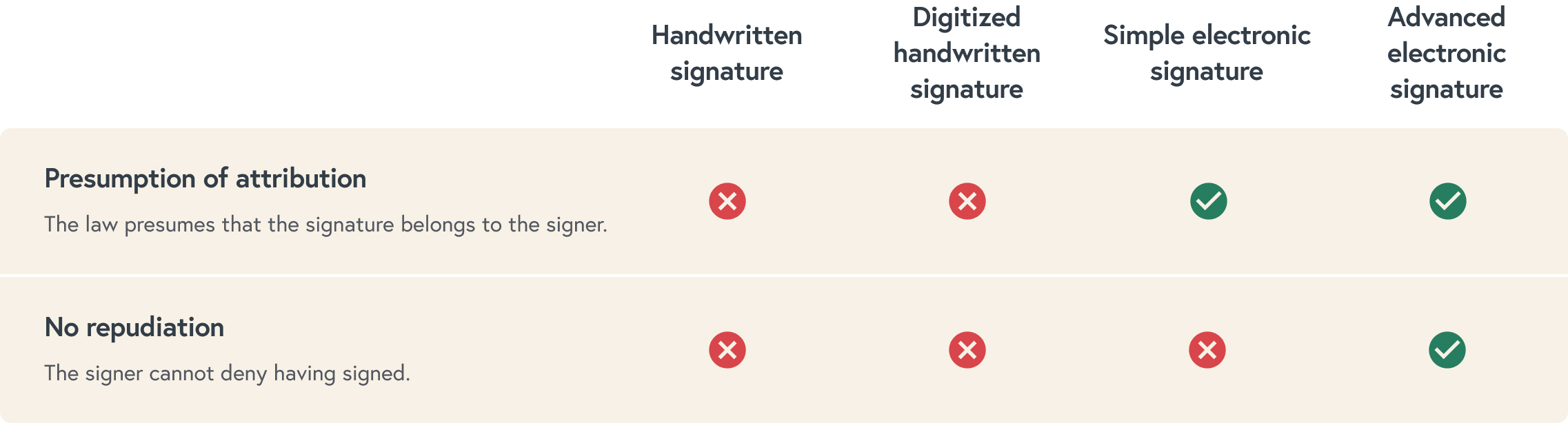


This advantage is conferred exclusively to the FEA, which is the gold standard for electronic signatures.
The non-repudiation guarantee makes it legally and technically impossible to deny the signature. If the signer denies their signature, they are required to present a cryptographic expert report to prove that the signature does not belong to them. To date, this situation has never occurred.


The presumption of attribution shifts the burden of proof to the signer in the event they deny having signed. This gives any electronic signature, provided it meets legal requirements, a significant legal advantage over a digitized handwritten signature. It is important to note that an electronic signature considered legally valid in other countries might not be recognized in Mexico (more on this later).


Although more and more people have an e.firma, it is not yet universal. Therefore, it may be necessary to offer alternative ways to sign. A simple electronic signature allows anyone with access to a computer or mobile phone and a valid official ID to sign electronically.
If you are going to sign with companies (or their legal representatives), keep in mind that they must have an e.firma due to tax requirements.

Contrary to popular belief, signing with an e.firma is not complex. Although this may vary depending on the design of each platform, the e.firma itself is not inherently difficult to use. In comparison, a standard electronic signature (FES) usually requires a more extensive process for signers, as it is recommended to collect supporting evidence, such as photos or videos of the signers and identity documents, to strengthen the legal robustness of the signature.

When evaluating international electronic signature platforms not specifically designed to meet the requirements of Mexican law, it is essential to verify whether the signatures they generate are recognized as an electronic signature.
Many international platforms allow users to digitally draw their handwritten signature, but this would be classified as a digitized handwritten signature rather than an electronic signature. Platforms that simply ask you to type your name or verify an email address might not meet the legal requirements to be recognized as an electronic signature.

As you can see, the decision isn't straightforward and depends on several factors, including:
- Who are the signers? Is it likely they have an e.firma?
- What is the likelihood that this document will be presented in court?
If it is likely that most or all signers have an e.firma, we suggest opting for FEA. This way, you will ensure the best legal protection, and signers will enjoy a simplified signing process.
If only some of your signers have an e.firma, you might consider a hybrid method, allowing them to sign with both FEA and FES.
With Mifiel, you have the flexibility to offer your signers both signing methods without compromising legal robustness. Our signing processes have been meticulously audited by experts to ensure you achieve successful outcomes in litigation.
Contact us via chat for guidance on implementing electronic signatures.







"Excellent customer service and a signature platform with 100% legal backing."
See moreCarlos Brito, Corporate Lawyer.

"I love Mifiel. It is an excellent electronic signature platform, very simple and practical to use. What I have liked most is the customer service they provide, in addition to the legal certainty it offers."
See moreJosé Refugio Gutiérrez, Legal Director

"For Fairplay to keep growing quickly, I need to ensure I have a provider that can keep up with our pace. We found what we needed in Mifiel, as they have grown their solutions right alongside us."
See moreJavier Lizardi, CFO.